Blog
Wheel Manufacturing Processes — Casting, Flow Forming & Forging

In the automotive wheel supply chain and B2B/OEM procurement, the manufacturing process is the single most critical factor dictating product cost, mechanical performance, weight, and market positioning.
Even when two wheels appear visually identical, differences in their internal microscopic grain flow can result in vastly different load capacities, fatigue life, and curb weights. This guide provides an engineering-level breakdown of Gravity/Low-Pressure Casting, Flow Forming, and high-pressure Forging.
1. Casting Processes: The Foundation of Mass Production
Casting remains the global foundation for OEM and entry-level aftermarket wheel production. This method involves melting solid aluminum alloy (typically A356.2) into a liquid and pouring or injecting it into steel molds.
1.1 Gravity Casting
- Operational Principle: Molten aluminum is poured into a steel mold from the top, relying solely on earth's gravity to fill the mold cavity before natural cooling and solidification.
- Physical Attributes: Free-flowing fill without external pressure often traps air, creating microscopic porosity and impurities. To maintain rated load capacities, engineers must use thicker walls (adding bulk mass). Consequently, gravity-cast wheels are noticeably heavier and more brittle, prone to cracking under high impacts.
- B2B Marketplace Value: Lowest production and tooling costs. Ideal for high-volume, budget-driven wholesale or replica markets where weight is not a primary concern.
1.2 Low-Pressure Casting
- Operational Principle: Utilizes mild pneumatic pressure (approx. 0.02 to 0.06 MPa) inside a sealed furnace to push the molten aluminum upward from a riser tube into a steel mold, allowing the metal to solidify under constant, controlled pressure.
- Physical Attributes: Bottom-up filling provides smooth fluid flow, drastically minimizing air entrapment. Internal porosity and shrinkage are vastly reduced compared to gravity methods. The resulting metallic density and mechanical fatigue life are significantly superior, offering a better strength-to-weight ratio.
- B2B Marketplace Value: Standard for over 85% of OEM passenger vehicle alloy wheels. Excellent for large-scale, cost-effective production runs (minimum orders typically ≥100 to 300+ units per mold).
2. Flow Forming: Balancing Weight and Performance
Flow forming (also called spin forging or rotary forging) represents a hybrid evolution, bridging the gap between cast economics and forged strength. It is a highly sought-after technology in the mid-to-high-end aftermarket.
   [ Cast Preform ]
          │
          ▼ (Heated & mounted onto a rotating mandrel)
   [ Hydraulic Rollers (Extreme Pressure) ] ───► (Extends & compresses rim outward)
          │
          ▼
   [ Flow-Formed Rim Barrel ] ───► (Produces dense, forged-like grain structure)
2.1 The Manufacturing Workflow
- A dedicated cast preform with a thick, short rim and fully formed face is produced via low-pressure casting.
- The preform is heated to 300 to 400 degrees Celsius and mounted onto a high-speed rotating mandrel.
- Dual hydraulic rollers apply immense radial and axial force, pressing and stretching the spinning barrel against the mandrel, extruding it to its target width and thinness.
2.2 Physical Benefits & B2B Fitment
While the spoke face retains a cast microstructure, the entire rim barrel—which sustains the highest dynamic bending stresses—undergoes a forge-like recrystallization. The severe compression aligns the metallic grain structure along the axial plane, significantly elevating tensile strength while reducing material wall thickness.
This process results in a 10% to 15% weight reduction over standard cast wheels without sacrificing crash toughness. It is the premier choice for mid-tier performance brands, offering moderate minimum order quantities (MOQs) and strong value.
3. Forging: The Pinnacle of Strength and Bespoke Engineering
Forging avoids melting the alloy entirely. Instead, it physically transforms solid 6061-T6 aluminum under immense press loads, creating the ultra-lightweight setups required for racing, hypercars, and premium custom setups.
3.1 The 1-Piece Forged Workflow
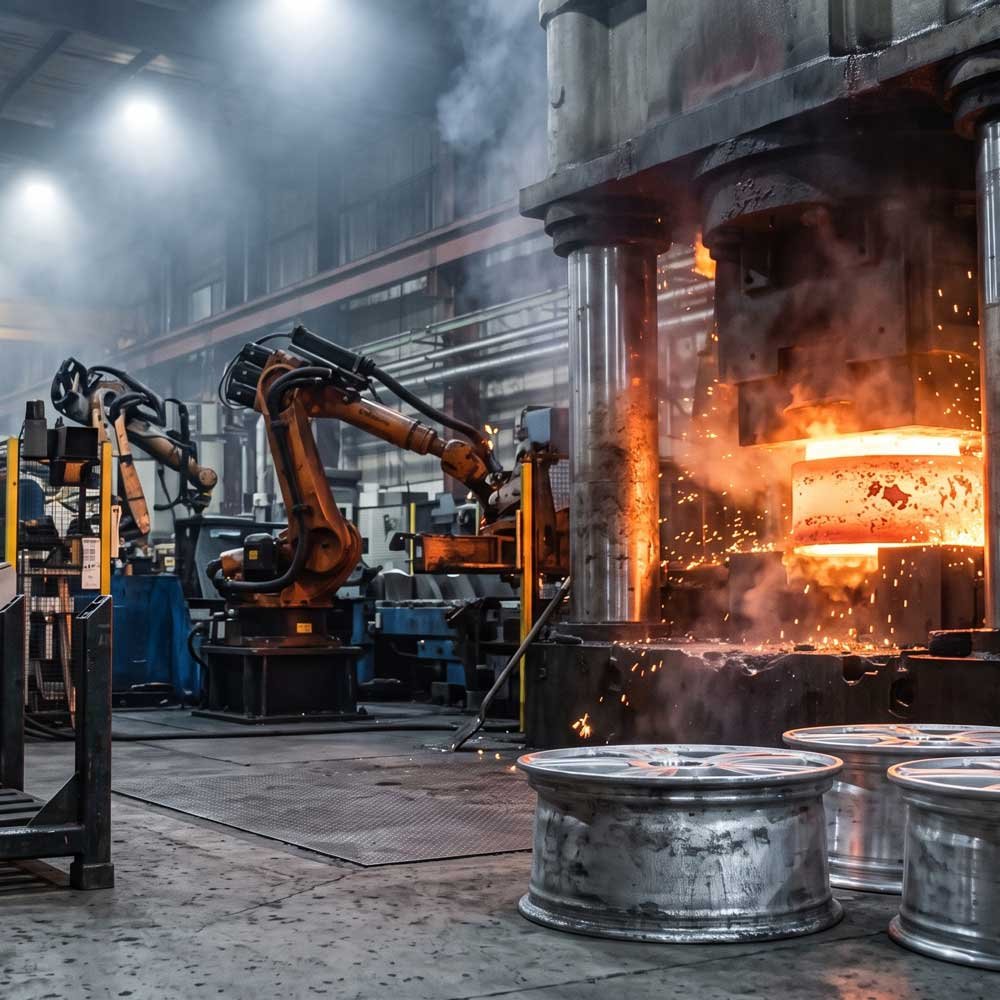
- Heavy Pressing: A heated billet of aerospace-grade 6061-T6 aluminum is compressed inside an industrial forging press (typically 8,000T to 12,000T) through successive dies, creating a high-density, solid wheel blank without spoke designs.
- Spinning: The blank’s outer rim is spun and rolled to extend the barrel to its target profile.
- CNC Machining: Advanced 5-axis CNC machines mill away the solid material to carve intricate spokes, lug pockets, and weight-reduction pockets according to specific digital CAD models.
- Finishing: The wheel is polished, brushed, anodized, or painted according to client specifications.
3.2 The Microscopic Grain Flow Secret
Cast aluminum is composed of randomly oriented, loose crystals prone to micro-voids (like packed sand). In contrast, forged aluminum under massive press loads forces the grain structure to flatten and stretch, creating a dense, continuous, and unidirectional "grain flow" (like woven fabric).
This structural integrity allows forged wheels to be engineered with incredibly thin spokes and reduces weight by 25% to 30% compared to casting. When facing high impacts, forged alloy bends and absorbs force without fracturing, offering unparalleled safety.
Since CNC machining requires no expensive steel casting molds, the MOQ is just 1 set (4 wheels), making it highly flexible for bespoke customization and fast prototyping, though at a premium cost.
4. Manufacturing & Commercial Comparison Matrix
| Comparative Dimension | Cast (Gravity/Low Pressure) | Flow Formed (Spin Forged) | Forged (1-Piece Forged) |
|---|---|---|---|
| Raw Material | A356.2 Aluminum Alloy | A356.2 (Face) / High-Strength Alloy | 6061-T6 Aerospace Aluminum |
| Metallic Grain Structure | Non-directional, loose, prone to porosity | Rim barrel compressed with axial grain stretching | 100% dense, continuous "Grain Flow" following wheel contours |
| Tensile Strength | 120 to 180 MPa | Barrel: 220 to 260 MPa (Spokes remain cast-level) | ≥ 310 MPa (throughout full component) |
| Weight Reduction | Baseline standard (Requires thick margins) | 10% to 15% lighter than casting | 25% to 30% lighter than casting (Extreme performance) |
| Impact Failure Mode | Shatters or fractures under severe forces | Deforms/cracks under high-stress thresholds | Bends/deforms under extreme impact without shattering |
| Tooling Costs (Molds) | High (Approx. $5,000 to $15,000 USD per spec) | Medium (Requires custom mandrel profiling) | Zero (Milled directly via CAD digital paths) |
| Order MOQ | High (Typically ≥100 to 300+ units) | Medium (Typically ≥40 to 100+ units) | Extremely Low (1 set / 4 wheels) |
| Fabrication Lead Time | Rapid (Seconds to minutes per cast cycle) | Moderate (Double stage cast and roll) | Slow (Hours per billet: extrusion & multi-axis CNC) |
| Target Segments | OEM production, mass budget replacement | Mid-market sport, consumer performance builds | Hypercars, motorsport, custom design bespoke niche |